

Study presents recommendations on involving society in historical memory initiatives
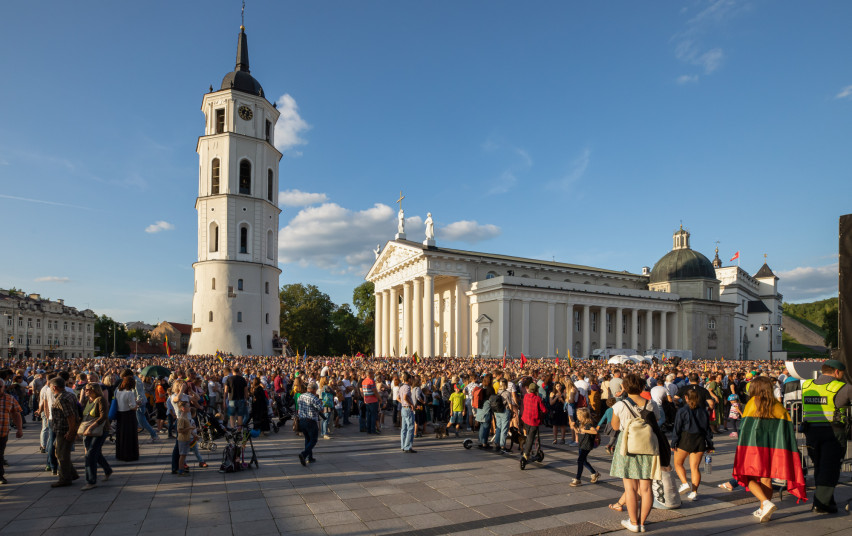
On Thursday (24 August), the results of an impact evaluation of the implementation of historical memory initiatives, including the topics of the Holocaust and the Soviet occupation, were presented. The evaluation had been ordered by the Ministry of Culture.
With this study, it was sought to prepare an analysis of the impact of the implementation of historical memory initiatives as well as proposals for more effective implementation of such initiatives and for improvement of the coordination mechanism.
The study analysed the organisation and coordination mechanisms of state holidays, observance days and commemoration years, evaluated the content, results and effectiveness of funded initiatives, and identified the attitudes and expectations of society and target groups. Individual semi-structured interviews were used to identify the experiences, attitudes and expectations of different social groups when participating in initiatives to mark state holidays, observance days and commemoration years, and to identify the challenges in the inclusiveness and effectiveness of their form and content.
Three focus-group discussions were also organised in cooperation with historians, event organisers, representatives of state institutions coordinating areas related to the study’s objective, employees of culture centres, and representatives of ethnic (national) minorities and youth organisations.
A review of best practice in seven countries was also performed, considering the experience of the Netherlands, Finland, Poland, Ireland, Latvia, Estonia and Czechia. For example, it is noteworthy that a National Committee was established in the Netherlands, by royal decree, for the organisation of the commemorations of key state events, holidays and observances. On the other hand, the study found that in many countries, there is no single institution organising all events to mark holidays or observance dates.
The study also considered historical memory initiatives related to the Holocaust and the Soviet occupation. It is recommended to learn from the experience of Estonia, Finland, the Netherlands and Poland, in which events for the remembrance of the victims of the Holocaust are coordinated not only by state institutions, but it is also sought to actively engage local Holocaust memorial organisations, historical memory institutions and the Jewish community.
The study presents the conclusion that optimisation of the coordination of the marking of observance days is needed, by creating an inter-institutional commission for the marking of observance days or by considering other alternatives. The initiation, preparation, and implementation of programmes marking observance days is based on the status quo of the responsible institutions, which is poorly regulated and lacks a coordination structure.
The analysis emphasises that regardless of age or ethnicity (nationality), participation in state holidays and historical memory events as well as the sight of various ethnic (national) symbols can inspire patriotism and pride, encourage a sense of responsibility, unity, community and the will to preserve freedom, and contribute to the well-being of the entire state.
The study’s results and recommendations will be used to guide the future implementation of initiatives to mark state holidays and observance days and to improve the coordination mechanism.
The impact evaluation of the implementation of historical memory initiatives, including the topics of the Holocaust and the Soviet occupation, was performed at the order of the Ministry of Culture by UAB “Ekonominės konsultacijos ir tyrimai” and VšĮ Socialinių inovacijų institutas (Social Innovation Institute).
Photograph courtesy of Gintarė Grigėnaitė
Last updated: 03-10-2023